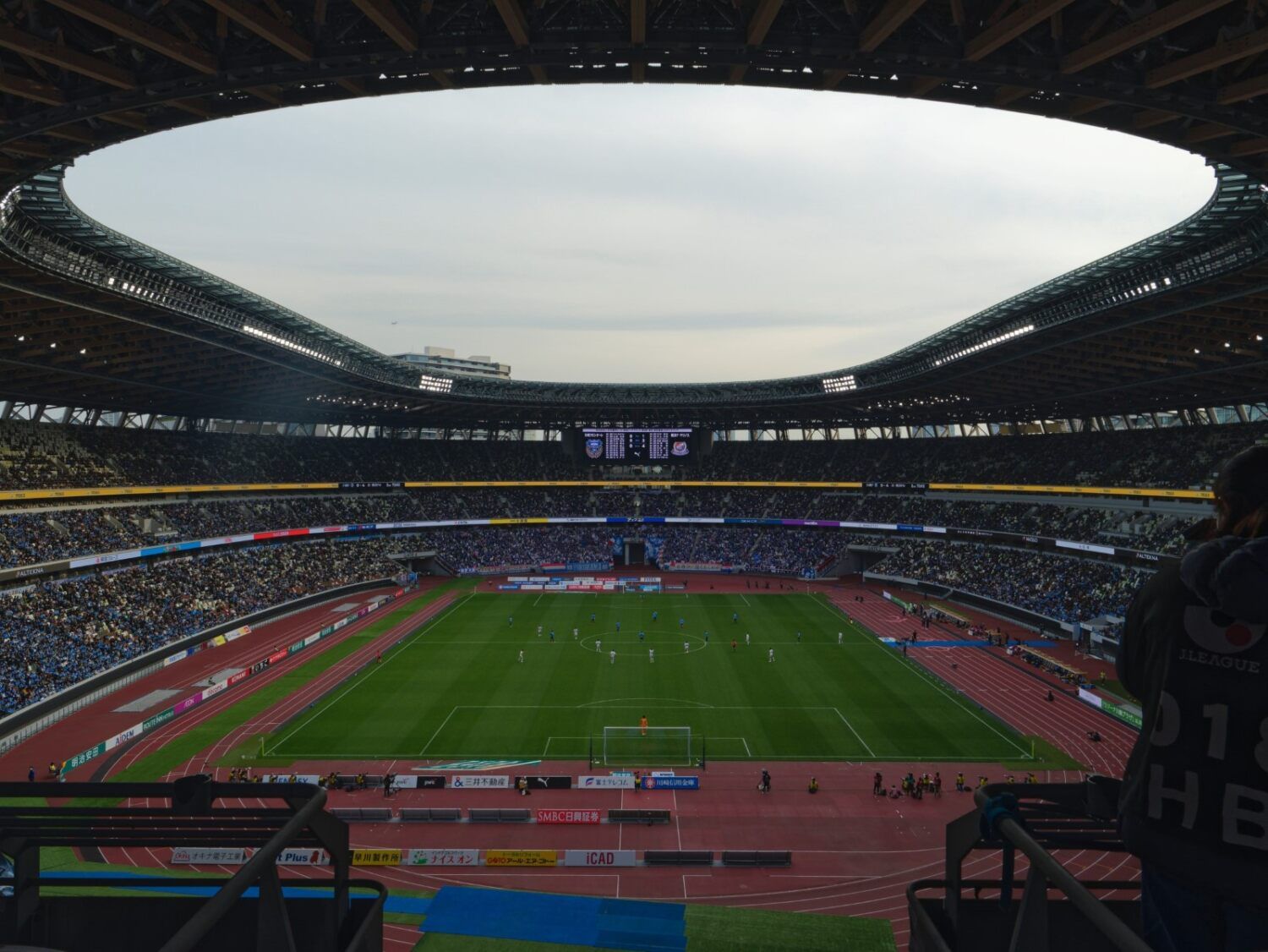
This is old news, but I’d like to share a story about how I went to see a J.League football match held at the National Stadium during the long weekend in late March.
As for the J.League, for personal reasons I’m rooting for J2’s Fujieda MYFC, and since they’re doing pretty well right now, I enjoy watching their weekly online streams. Unfortunately, though, there are no matches for my team in the Tokyo area during the 2026 season, so I won’t be able to see them play in person. I had pretty much resigned myself to the fact that there was nothing I could do about it.
Amidst all this, I happened to get tickets for the J1 match between Kawasaki Frontale and Yokohama F. Marinos at the National Stadium. I don’t have any particular attachment to either team, but since they’re both powerhouse, prestigious J1 clubs, I decided to go just to enjoy watching a game at the stadium for the first time in a long while.
Since I hadn’t been there in so long, in fact this was my first visit to the New National Stadium.
I feel like it’s more convenient now that it’s closer to the JR stations (Sendagaya, Shinano-machi) than the old Stadium was.
Let’s take a photo from the usual angle.
This time, in addition to the LUMIX G9PROII, the Leica DG 12-60mm, and the Leica DG 50-200mm, I brought along the DMW-TC20A teleconverter, figuring I’d need a long-range lens since I’d be shooting from the massive stands at the stadium.
Attaching the teleconverter to the 50-200mm lens allows you to bring subjects surprisingly close. It’s possible, but it’s actually quite difficult.
Here are Frontale’s mascots, “Furonta” and others. With subjects like this—where you can simply frame the shot, aim, and press the shutter—I can usually get decent shots.
Scene from the pre-match photo session. In hectic events like this, the focus starts to get a bit shaky right away.
Once the match gets underway, everything moves so fast that I simply can’t capture the key moments through the viewfinder. Even if I manage to get a shot by chance, it’s practically impossible for me to adjust the focus or composition. Here are two shots I took of the scramble in front of the goal, swallowing my pride.
Both were captured at the exact moment the goalkeeper made a save; it felt less like I took them and more like they just happened to be in the frame by chance. When I try to imitate this and end up with such unflattering photos, I’m reminded once again that the skill of photographers and the performance of their equipment required to capture “that decisive moment” or “a dynamic shot of a top-tier athlete” are on a level I can’t even begin to imagine.
Also, and this is on a completely different level from my own photography skills, but J1 matches are definitely better and faster than J2 ones. I should have given up on taking photos sooner and just watched the game more closely.
Well, the match itself surprisingly turned into a one-sided affair for the away team, Yokohama F. Marinos, which was a shame for the Kawasaki Frontale supporters. Even so, the passion of the fans behind the goal—waving their flags and chanting their hearts out despite being outmatched—was quite moving. That’s exactly how soccer fans should be.
Finally, the camera pans out to the area outside the stadium. In stark contrast to the frenzy in the stands, the scenery toward Yoyogi is fading into twilight.
The overcast sky created a slightly melancholic atmosphere, which had a certain charm.
It had been a while since I’d been to the National Stadium, and it was fun to walk around and take photos objectively while watching a football match for the first time in a long while. If it had been a Fujieda MYFC game, I probably wouldn’t have been able to walk around and take photos so calmly.