One day I went to Yokohama’s Chinatown to buy something.
Even though it was the dead of winter, it seemed like tons of people had the same idea as me—“Let’s pop over to Chinatown”—and it was quite crowded.
Escaping from the particularly crowded and difficult-to-walk-on Chinatown Main Street, as usual, toward the Guan Di Temple.
Even though this blog has almost zero influence, I deliberately won’t go into details because I don’t want to contribute even a little to further congestion. After buying my favorite items at my favorite store, I thought, “Well, what now?”
I could have just headed home, but the weather was nice, so I decided to make a little detour to Yokohama.
Rinko Park in the Minato Mirai district.
I’ve been to the huge exhibition hall “Pacifico Yokohama” several times for both personal and business reasons, but this was my first time coming to this park, located on the seaward side facing Yokohama Port, where the shore gently curves.
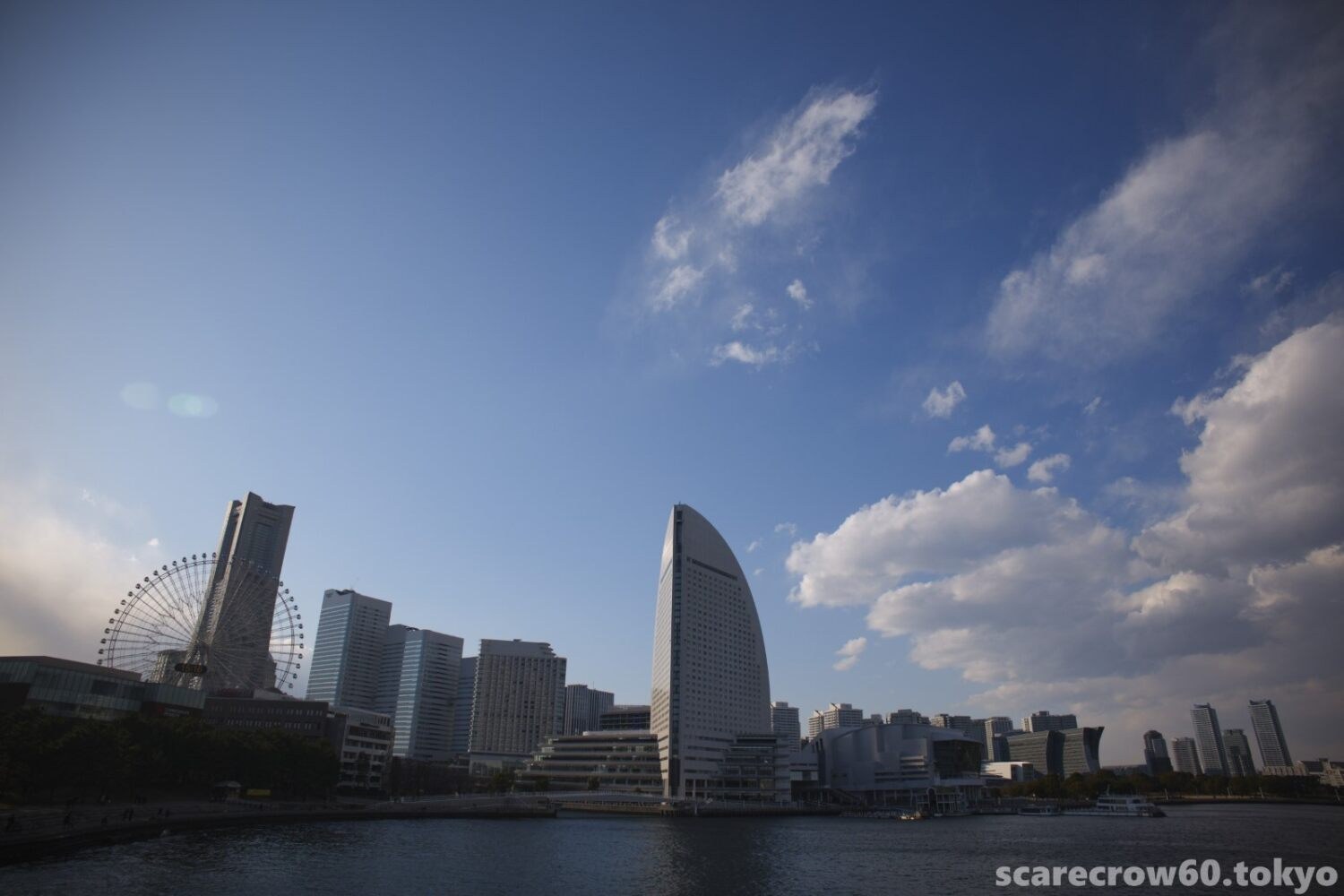
The large fan-shaped building is the InterContinental Hotel, likely nationally recognized as a symbol of Yokohama Port. The park spreading at its base is, for lack of a better phrase, entirely a “place of relaxation for citizens.”
The “Shioiri Pond,” which draws in seawater, had receded significantly at this hour, transforming into a tidal flat that served as a playground for children.
A monument modeled after a ship’s anchor. A hammerhead crane is visible in the background.
Silhouette of the Ferris wheel backlit on the landward side, seen from the pedestrian bridge spanning the harbor at the southern end of Rinko Park.
Walking up to the hammerhead crane I saw earlier, I look back toward Minato Mirai. The clouds looked great against the blue sky, so I snapped a postcard-style photo.
The harbor wind was quite cold for late January, but we were blessed with good weather, making for a very enjoyable photo walk at Rinko Park.
All photos this time were taken with the LUMIX S1IIE and SIGMA 20-200mm. Since DxO hasn’t released the lens profile yet, some photos show noticeable vignetting and distortion. For now, I’ll just leave them as is and insist, “This is part of the lens’s character.”