Continuing from the previous article. Lunch at Hisago Sushi near Keikyu Kurihama Station was delicious as expected, but even after finishing, I couldn’t come up with a particularly good plan.
Back at the station, I learned new information: Keikyu Line service wouldn’t resume for nearly another hour. I gave up on “going to Shioiri and touring the Yokosuka Naval Port” and decided to change plans.
So, where to go next? Tsukuihama? Or maybe shoot some scenery at Kurihama Port’s wharf? But the sky was overcast, and the sea color wasn’t looking great… While pondering this in front of the Tokyo Bay Ferry bus stop, a Keikyu bus bound for “Chiyogasaki” arrived.
Chiyogasaki… I’ve seen that place name somewhere recently. I remembered seeing something definite on the map I looked at while walking around Uraga in the morning, so I quickly asked Google… and made an instant decision. For the second half of my “solo excursion,” I jumped on the bus to head to this place, which wasn’t in my original plans at all.
A little over a 20-minute walk from the Nagase 2-chome bus stop. I realized along the way that since it’s a “Cannon site,” it must be on high ground. Walking around Yokosuka, we’re bound to encounter steep uphill climbs, and sure enough, I got stuck on another one this time. Wheeze, wheeze.
At the top of the climb was a military fortress built during the Meiji era to guard Tokyo Bay. For detailed information on the historic site, please visit the official Yokosuka City website.
It’s a proper national historic site. I joined a 45-minute guided tour inside the site led by a local volunteer.
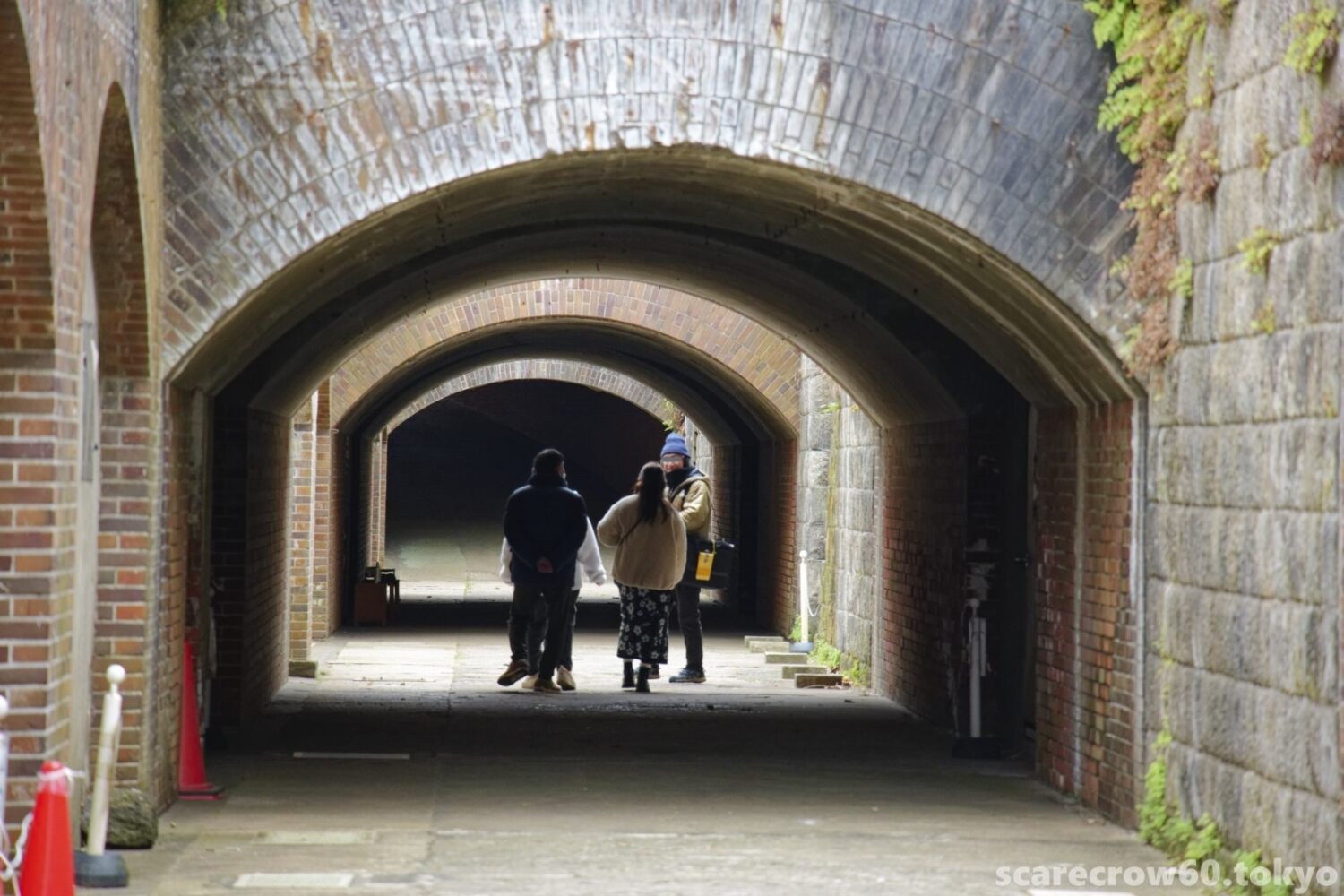
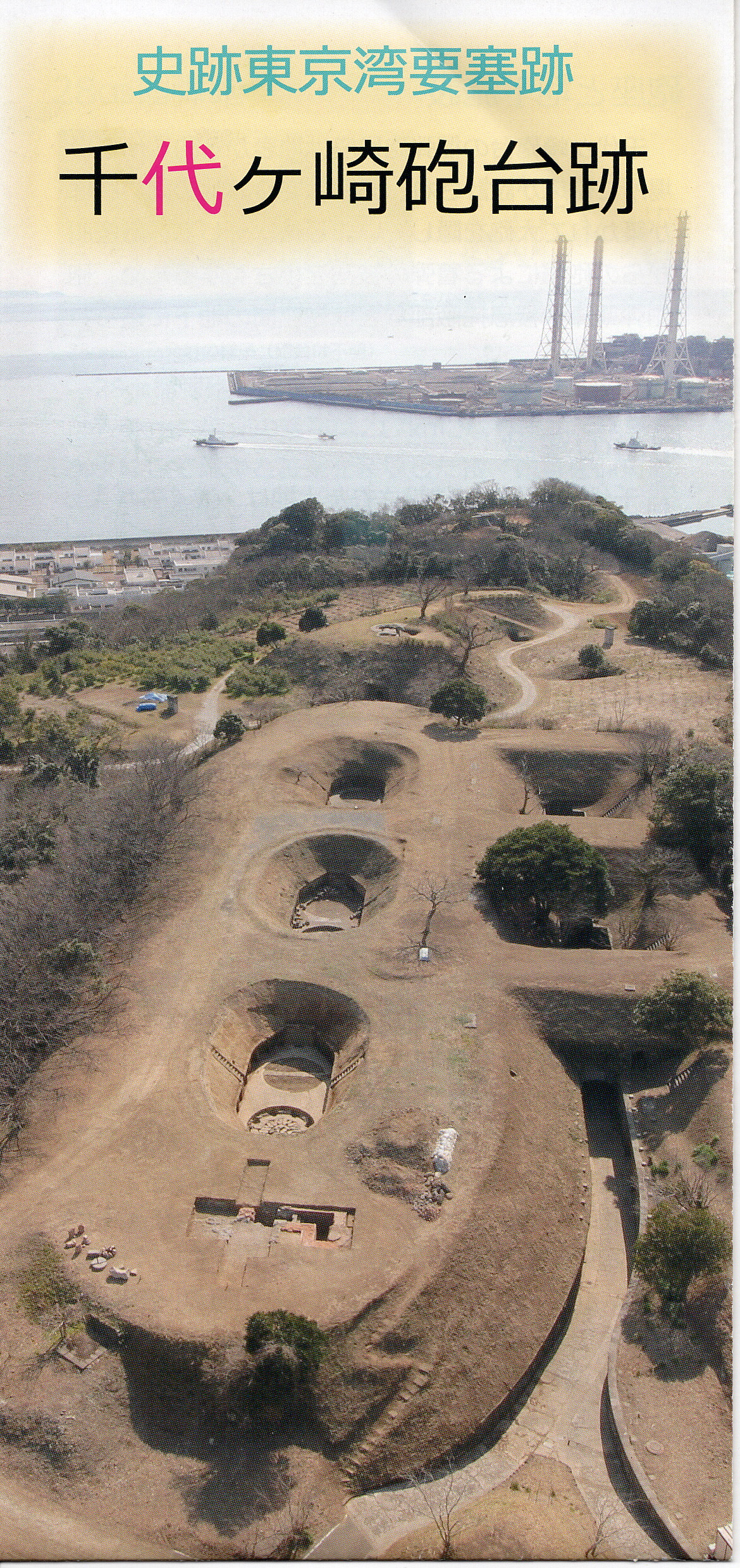
We proceeded along the semi-underground passageway (called a “ruido”) dug along the right side of the gun emplacement ruins, as shown in the photo on the cover of the pamphlet above.
This pathway made of stone and brick is photogenic, possessing a certain majesty in addition to its practicality as a fortress. According to our guide, an AKB-affiliated idol group filmed a music video here several years ago.
The three existing gun emplacements originally housed six 28cm howitzers, intended for maritime defense of Kannon-zaki and the entrance to Uraga Bay (to intercept enemy ships approaching the capital).
After the battery was constructed during the Meiji era, the guns were fortunately never fired at enemy vessels and were later removed, leaving the site as ruins. However, from 1960 to 2010, it was used as a tele-communication facility by the Japan Maritime Self-Defense Force (JMSDF). Signs for identification and caution from the JMSDF era remained scattered about, and holes for wiring and piping were visible, giving the site a vivid sense of its military past.
The well’s water vein still seems alive, and the water inside was clear. Was it put to some practical use by the JMSDF?
This is the underground passage leading from the rampart to beneath the gun emplacement. It’s quite peeled away, but the brick walls are plastered.
Climbing the narrow staircase, we finally reach the gun emplacement ruins.
To prevent the heavy cannon from sinking or tilting, the stone foundation built using British civil engineering techniques remains intact for this single gun mount, just as it was when constructed.
Based on Meiji-era technical standards, the gun emplacements were built hidden at the bottom of the pit to make them harder for enemy ships to target. However, in later eras when aerial reconnaissance and attack became commonplace, even this deep pit may have lost much of its significance.
※If you’re thinking, “But then we can’t see the enemy from here either,” you’re absolutely correct. That’s why an observation post was set up on the ground beside the battery to relay direction and distance. The remains of that speaking tube were also preserved.
I also heard that when it was used as a JMSDF communications base, this pit was filled in and communications equipment was built on top. They dug it out again when opening it as a historic site. What a lot of work.
Reaching the top of the site, you’re high up on the mountain with a wide view over Tokyo Bay. I realized this was truly a crucial fortress guarding the bay entrance, as its howitzers could reach all the way to the coast of Uchibo on the opposite shore.
Now, I feel bad for the guide who gave such an enthusiastic explanation, but it was a bitterly cold day. Especially toward the end of the tour, standing exposed on the battery, I got so cold I couldn’t concentrate on listening anymore. With the departure time for the bus line I wanted to take approaching, I excused myself here and headed back down the mountain.
I ended up taking a bit of a shortcut at the end, but considering I stumbled upon it instantly by chance, it was an incredibly rich and immersive fortress tour experience – the chapter of visiting the Chiyogasaki Cannon site Ruins. Yokosuka still seems to hold many depths.
※Bonus Topic
To make good use of the ticket included with Keikyu’s “Yokosuka Full Enjoyment Pass,” I instantly selected an option from the pamphlet. On my way home via the Keikyu Line, which had resumed operations, I picked up a souvenir.

The “Kurokarin” from “Izumiya” near Yokosuka Chuo Station was absolutely delicious. My instant choices of the day were pretty sharp.