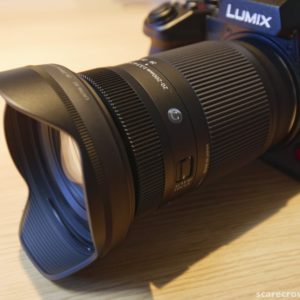
Anyway, I figured I had to start shooting to get going, so I headed out with my LUMIX S1IIE and SIGMA 20-200 F3.5-6.3 DG. There’s no big reason, but whenever I get new gear, I somehow end up here more often—around Shinagawa Minato Park/Oi Racecourse.
The weather was decent enough, so I snapped away indiscriminately and headed home. As usual, I started processing a few RAW files, but…
Hmm…?
Ah, this won’t do.
No, it’s not that the camera or lens is bad, you see.
My RAW development tool, PhotoLab 8, already had the S1 II E camera profile installed. However, the lens profile for the SIGMA 20-200, which had only recently been released, wasn’t registered yet. Without it, I couldn’t correct for the lens’s various aberrations or vignetting, so I could only get an unprocessed image (from the lens’s perspective). So, this wasn’t a test run where I could check the final look using my usual routine.
Oh well. Since I can’t do anything advanced like checking aberrations, I’ll just fill this article with my impressions of using the camera and lens.
The camera body design is an extension of the familiar S5 and G9PROII, so I had zero confusion about handling it. It responded crisply and smoothly with my usual, practiced operations.
As for the lens, given the circumstances above, it was less than a proper test run. Even so, two distinct features of this lens were immediately apparent, even to an externall beginner like me.
1) Significant angle-of-view difference across its 10x zoom (20mm to 200mm)
2) Significant vignetting at the wide-angle end
Let me show you both together.
Wide-angle end: 20mm, F3.5 (wide open). A wide field of view and obvious peripheral light falloff.
Zooming in slightly to 24mm・F4. Looking at the corners, there’s still a bit of vignetting remaining, perhaps?
While stopping down doesn’t improve light loss, so software correction is inevitable. We have to aware of this as a characteristic of this lens.
Then, zooming in sharply to the telephoto end at 200mm and F6.3. Quite a dynamic change in the angle of view.
However, coming from an APS-C to MFT camera, a full-frame 200mm feels rather awkward as a telephoto lens. I’ll need to gradually get used to this focal length going forward.
And while it’s still too early to definitively call it the 3rd feature, the high resolution seems quite impressive, just as the pre-release hype suggested.
Also, my thoughts on the weight. At 550g, it’s nearly 20% lighter than the official standard “small trinity” LUMIX S 24-105mm F4 I’ve using (680g). Handling it in the park, I definitely felt the benefit of its lighter weight, at least as advertised.
Finally, I’ve seen some reviews mentioning that “the zoom ring is stiff and hard to turn,” but I didn’t find it “stiff” or difficult to turn. What confused me when turning it wasn’t the stiffness, but the reverse rotation direction compared to the genuine lens. It might feel a bit awkward until you get used to it.
Anyway, while it’s still below trial operation level, these were my initial impressions of the new camera and new lens.