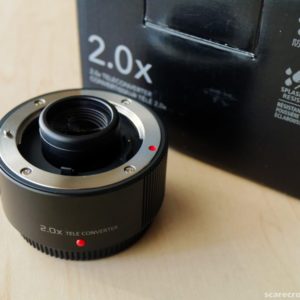
I’ve got a new teleconverter, but when I think about it, the only time I’ve used a teleconverter in the past was when I attached an old lens and an old teleconverter to my PENTAX K-70 via an adapter and took pictures using MF and actual aperture metering.
I wonder what it would be like to use the latest digital SLR camera and lens in combination with a teleconverter with electronic contacts? I’ll have to try it out right away.
So, I attached the Leica DG50-200 F2.8-4.0 + DMW-TC20A to the LUMIX G9PROII and took some test shots.
The following photos were taken in RAW and developed in PhotoLab. I applied the DCP profile “Landscape” without correcting for distortion, sharpness, exposure, etc.
200mm F8 → 400mm with teleconverter (800mm FF equivalent)
This is the longest focal length photo I have ever taken. I tried to check the resolution by zooming in to 100% near the bottom right corner.

I can’t do any scientific analysis, so I’ll just talk about my impressions, but I think the lens and teleconverter are both excellent, as the photo clearly shows the shadows of the branches falling on the blue steel structure and the details of the wire mesh.
Next, let’s compare the photo taken with the teleconverter and the photo without the teleconverter at the same angle of view. First, here is a 200mm panoramic view taken with a 100mm f/7.1 lens and 2.0x teleconverter.
I prepared a same angle photo with the naked 200mm F8 lens, and compared them by magnifying the lower right corner to the same size.
Left: 100mm x 2.0x teleconverter F7.1, Right: 200mm F8 (400mm equivalent)


If you ignore the fact that the aperture is slightly different due to my usual carelessness (whoa, whoa), fortunately there is no difference in the resolution of the two lenses to my untrained eye. Rather, the poor skill of the photographer who can’t get the focus to be exactly the same is more noticeable, hmm.
Or rather, it’s amazing, or literally a blessing, that you can use this long-distance cannon so casually with your hands.
Finally, here is how the camera behaves when a teleconverter is attached, and how the software behaves when handling the data that has been taken. I feel so much better now that I understand all these things!
1) The camera displays the focal length with the teleconverter attached as it is. When the teleconverter is attached and the lens zoom ring is set to 200mm, the display shows 400mm.
2) When the teleconverter is attached, the maximum aperture automatically becomes darker. When shooting at the maximum focal length of the Lica DG50-200 F2.8-4.0, the minimum aperture that can be set in aperture priority mode is F8.
3) When checking the properties of the JPG data on the PC, the focal length is recorded as the distance with the teleconverter attached (same as 1 above). Also, the lens model is recorded as “LEICA DG 50-200/F2.8-4.0+TC2.0” together with the teleconverter.
4) DxO PhotoLab 8 has dedicated correction data for the lens + teleconverter set, separate from the correction data for the lens alone (see below: import dialog).

*The above is a personal memorandum of what I observed. When making important purchases, please do not take my word for it, but make your own judgment. Just to be sure.
This article has ended up being a bit information-heavy, but in short, it was a story about how I was pleasantly surprised by the results of my test shots using the genuine LUMIX MFT mount teleconverter.