The Leica Monochrome photo style, which proudly bears the Leica name, has been included in LUMIX G9PROII and later cameras by Panasonic.
With this, it seems that the positioning of the photo style with the name “L Monochrome” that was full of consideration for adults will become difficult, but Panasonic has done a rather savory thing by allowing them to coexist. Well, I don’t dislike L Monochrome, which has a rather good flavor, so I’m fine with them coexisting.
Leaving that aside, since it’s a Leica-certified photo style, I wanted to give it a try, so one fine autumn day in mid-October, I went for a monochrome walk around Shibaura, Tokyo, with the G9PROII, Leica DG8-18mm, and Leica DG12-60mm in hand.
I thought I’d captured the Rainbow Bridge in a nice wide-angle shot, but the weather was too good and it ended up with a flashy ghost image.
Oh yes, I basically take photos in RAW format and develop them using Photolab, so I have to say that the Leica Monochrome photos are not straight from the camera, but rather they are RAW photos developed using Adobe’s DCP file of the same name in Photolab.
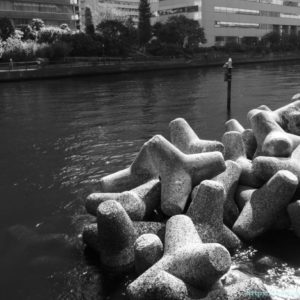
The harbor scene, painted in shades of black and white, is not to be despised.
I didn’t know that you could go up and down the bridge from the bottom to the top in an elevator. I managed to get one photo through the gaps in the metal mesh.
Perhaps it was because a weekend with just the right weather, but I was a little surprised to see so many people walking/running across the bridge. I took a few photos and then hurried back.
This is the pier where the pilot boats that guide ships through Tokyo Bay are moored. It was quiet and there was no movement, probably because it was the weekend.
What do you think, Leica Monochrome?
It’s just my impression, because I haven’t been able to verify it quantitatively, but it has a fine level of detail, and it’s not prone to blown highlights, and it also retains a good amount of gradation in the dark areas. The contrast is low-key, and it feels like it has a wide dynamic range… but even if I say that, it’s not like the dynamic range can expand beyond the camera’s performance just by specifying a photo style, so I’m not sure what the mechanism is, but I guess that’s just how it feels.
I’ve always liked monochrome photography that uses a coarse grain and high contrast to create a powerful effect (for example, PENTAX’s “Hard Monochrome”), but this is the exact opposite of that.
It’s the complete opposite, but I think to myself, “This is good too”. I really have no principles.
No principles and I kind of like it, I’ll continue my black and white walk a little longer next time.